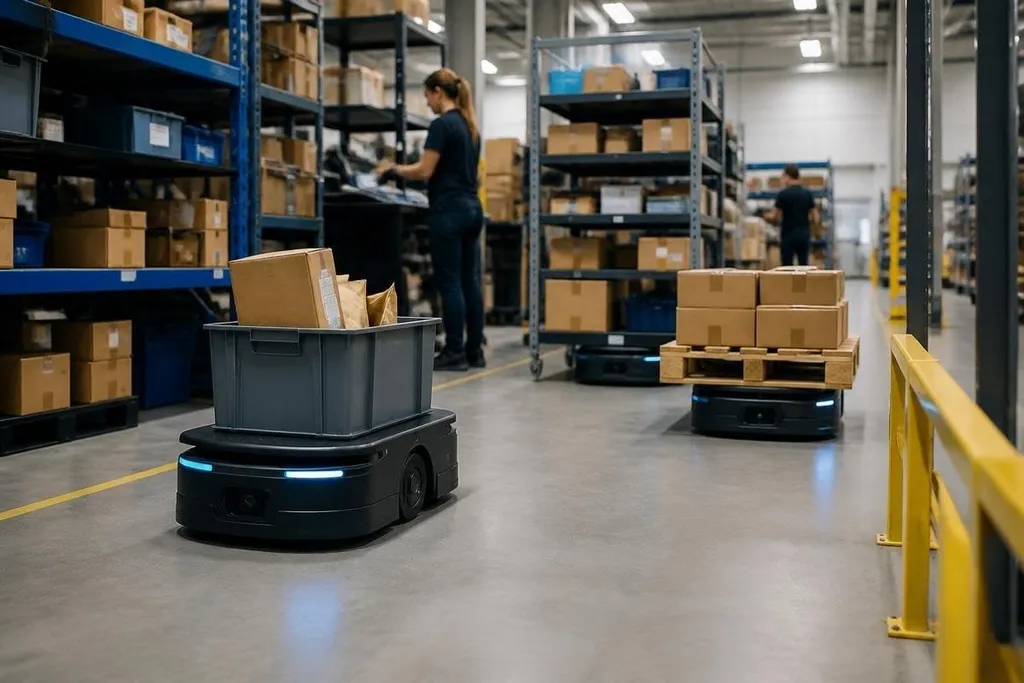
A logistics robot can move a tote, carry a pallet, or bring a shelf to a worker.
That can reduce walking and keep goods moving, but the result depends on the floor plan, software, and work the robot must handle.
- Autonomous mobile robots move loads through marked or mapped warehouse areas
- Robotic arms can pick, place, sort, and pack items
- Safety sensors stop work when people or objects enter the robot’s path
Where logistics robots help
The clearest use is repeated movement. An autonomous mobile robot, or AMR, can take a tote from storage to a packing station and return for another load. LiDAR, cameras, or other sensors help it locate shelves, people, and obstacles as it travels.
That removes some walking from a worker’s shift. It can also make the handoff between storage and packing more regular, since the robot follows a software task rather than waiting for a person to fetch each tote.
Automated guided vehicles, known as AGVs, work in a more fixed way. They may follow floor markers, magnetic tape, or set routes. AGVs fit sites with stable layouts, while AMRs can handle more changes in their travel area.
Robotic arms suit a different task. A fixed arm can sort parcels, place products in cartons, or move cases between a conveyor and a pallet. Its value comes from repeating the same motion with the same reach and timing, provided the items arrive in a form the gripper can hold.
A fixed arm's reach and gripper set the first boundary: the parcel, carton, or case has to arrive where the tool can hold it. Reports from Robot 24 can add the model, task, test site, and result before you compare the claimed labor saving with the work left for staff.
The limits show up at the edges
A robot works best when the job stays within its design.
A gripper built for boxes may fail on soft bags, loose cables, or items with changing shapes. An AMR may stop when a pallet blocks its route, then wait for a person or software rule to clear the problem.
That pause matters. Even one that moves well for most tasks can still slow a whole area when it cannot decide what to do with one unusual item. The exception needs a clear handoff to a worker, not a silent stop that leaves the order queue waiting.
Software links matter just as much as the hardware. The robot may need data from a warehouse management system, a fleet manager, barcode scanners, or conveyor controls. A bad location record can send a robot to the wrong rack, even when its motors and sensors work correctly.
Safety adds another limit. People and robots share space, so the site needs marked routes, speed rules, emergency stops, and checks for blind spots. A sensor can detect an object without knowing whether it is a loose strap, a fallen product, or a person reaching into a work area.
The cost is more than the robot
The purchase price is only one part of the project.
A site may need chargers, network changes, floor markings, software links, spare parts, training, and a plan for service when a unit stops.
The work also changes for people. Workers may walk less, yet spend more time loading robots, clearing blocked routes, checking exceptions, or fixing labels. That shift can help a site if the new tasks are planned and taught before the robots arrive.
Maintenance needs a place in the plan from day one. Wheels wear, batteries lose capacity, sensors collect dirt, and grippers need adjustment. A robot fleet without spare parts or service coverage can leave a busy station waiting on one failed unit.
I’d start with one repeated task and measure its effect before buying a fleet.
A practical check before rollout
Use these questions before you approve a logistics robot project:
- Name the task: Write the load, route, handoff, and exception the robot must handle.
- Map the site: Check floor condition, door widths, lifts, people, traffic, and emergency exits.
- Test the data link: Confirm that item locations, orders, scans, and robot jobs match.
- Set the human handoff: Decide who clears a blocked route or handles an item the gripper cannot pick.
- Count the support work: Add charging, cleaning, service, spare parts, training, and software support.
- Set the measure: Track completed moves, stopped jobs, worker time, damage, and safety events.
A small pilot can answer the questions a sales demo leaves open: how often routes block, how long recovery takes, and which items fail at the gripper.
Those results tell you if the robot fits the work or if a simpler conveyor, cart, or process change makes more sense.
The useful next step is a measured pilot with a named task, a human fallback, and a stop count that the site can check each shift.